Revise the types and functions of lipids, food sources, cooking properties and links between dietary fats and health. Open the explanations, practise a quick knowledge check, then choose Practise exam questions to test your understanding. You can return to these notes whenever you need them.
Dietary fats are lipids that occur in animal and plant foods. Their physical and chemical properties influence uses in food.
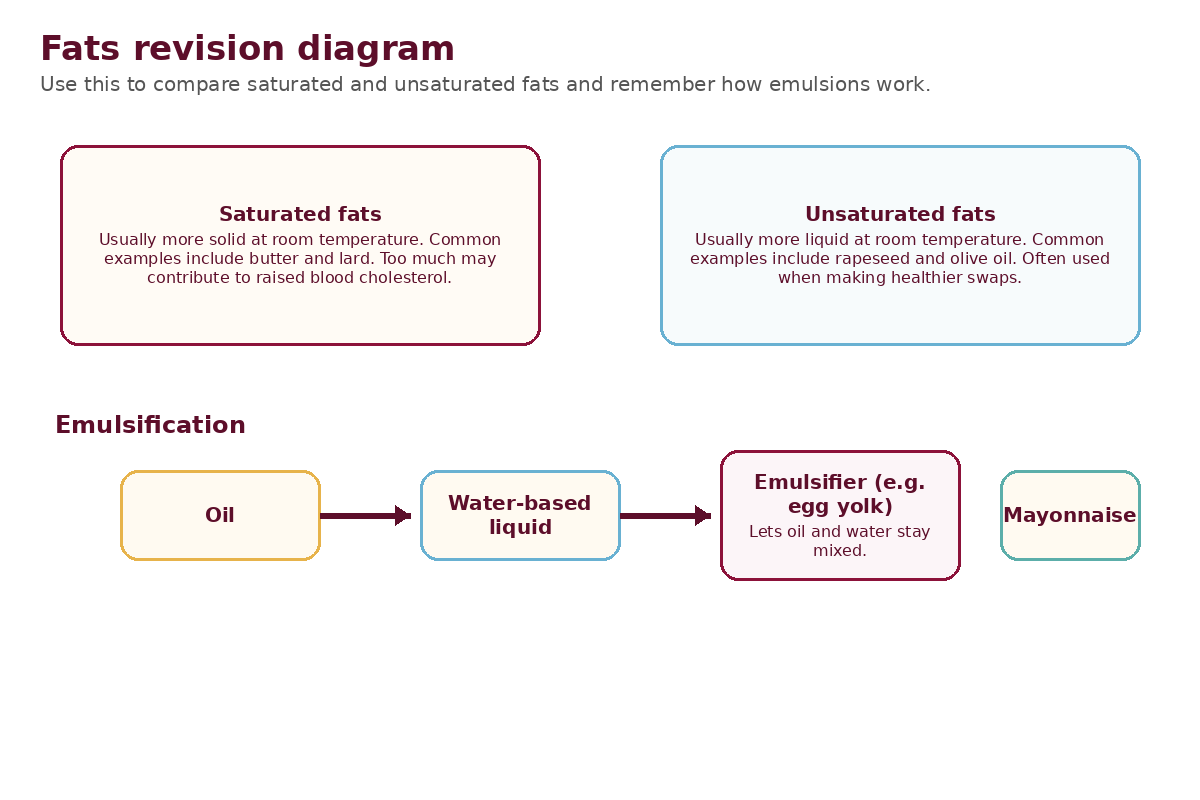
Saturated and unsaturated fats plus a simple emulsification reminder.
Saturated fatOften more solid at room temperature and may be linked with higher blood cholesterol.
Unsaturated fatOften more liquid and commonly used in healthier swaps.
EmulsifierAn emulsifier helps oil and water stay mixed.
ExampleMayonnaise is a common emulsion using egg yolk as the emulsifier.
Fats versus oils+
At typical room temperature, fats are usually solid or semi-solid (for example butter or lard), whereas oils are usually liquid (for example olive or sunflower oil). Temperature and fatty acid composition affect this.
Triglycerides+
Most fat in foods is present as triglycerides, made from glycerol and three fatty acids. Fatty acid types and chain structures influence melting point and stability.
Saturated, monounsaturated and polyunsaturated+
Saturated fatty acids have no carbon–carbon double bonds; monounsaturated have one; polyunsaturated have more than one. These features affect the way a fat behaves and its nutritional contribution.
Visible and invisible fats+
Visible fats include oil added during cooking or butter spread on bread. Invisible fats occur naturally inside foods such as cheese, nuts, seeds, meat and pastries; labels can help identify them.
Quick knowledge checkThink first, then reveal
How does an oil usually differ from a fat at room temperature?
Reveal explanation ⌄
An oil is generally liquid, whereas a fat is generally solid or semi-solid.
Fats are an important nutrient and have several biological functions beyond supplying energy.
Energy and storage+
Fat provides approximately 9 kcal (37 kJ) per gram and is a concentrated energy source. The body can also store energy as fat for later use.
Insulation and protection+
Body fat helps insulate against heat loss and cushions some internal organs. A suitable amount of dietary fat contributes to healthy body functions.
Fat-soluble vitamins+
Dietary fat helps the body absorb vitamins A, D, E and K. These vitamins have different roles, including vision, bone health, antioxidant activity and normal blood clotting.
Essential fatty acids+
Some polyunsaturated fatty acids, including certain omega-3 and omega-6 fats, are essential because the body cannot make enough of them. Sources include oily fish and selected plant oils, nuts and seeds.
Identify food sources and compare their nutritional profiles without assuming one ingredient alone makes a meal balanced.
Sources of saturated fat+
Butter, cream, cheese, fatty cuts of meat and some pastries can supply saturated fat. Coconut and palm oils also contain high levels compared with many other plant oils.
Sources of unsaturated fats+
Olive and rapeseed oils, nuts, seeds and avocados supply mainly unsaturated fats. Oily fish contributes long-chain omega-3 fatty acids.
Dairy fat+
Whole milk, cream, butter and many cheeses contain different amounts of fat. Skimmed milk contains much less fat than whole milk while still providing protein and calcium; always compare a particular product.
Cooking method and overall food+
Shallow-frying, deep-frying and adding rich sauces can increase a dish’s fat content. Grilling, baking or steaming may use less added fat, depending on the recipe.
Quick knowledge checkThink first, then reveal
Name one food that provides mainly unsaturated fat.
Reveal explanation ⌄
Examples include olive oil, rapeseed oil, avocado, walnuts or sunflower seeds.
Distinguish dietary fats from blood cholesterol and explain why dietary balance matters.
LDL and HDL+
Cholesterol travels in the blood within lipoproteins. LDL carries cholesterol to tissues and high LDL concentrations are associated with greater cardiovascular risk; HDL helps transport cholesterol back towards the liver.
Saturated and trans fats+
Replacing some saturated fat with unsaturated fat can help support healthy blood cholesterol levels. Industrial trans fats are associated with adverse cholesterol effects and are restricted in many food systems.
Broader influences on cardiovascular health+
Cardiovascular risk is influenced by many factors, including physical activity, smoking, family history and overall dietary pattern. Foods containing fibre, fruit, vegetables and unsaturated fat can form part of balanced eating.
Reading nutritional labels+
Compare total fat and saturates separately, ideally per 100 g as well as per portion. Products with equal total fat can contain very different amounts of saturated fat.
Quick knowledge checkThink first, then reveal
Why might replacing butter with a suitable unsaturated oil be advised in some recipes?
Reveal explanation ⌄
It can reduce saturated fat and increase unsaturated fat, supporting healthier cholesterol levels when part of the overall diet.
Fats change the structure, texture, flavour and handling properties of pastry.
Shortening action+
In shortcrust pastry, fat coats particles of flour and limits gluten development by reducing hydration/contact. This encourages a short, crumbly texture rather than a stretchy dough.
Rubbing-in+
Cold fat is rubbed into flour until a breadcrumb-like texture forms. Limited handling and measured liquid help keep the finished pastry tender.
Lamination+
Puff and flaky pastries use layers of dough and fat. During baking, water turns to steam and helps push layers apart; the fat separates layers and contributes to texture.
Too much or too little fat+
Too little fat can contribute to a tougher texture; too much can make pastry greasy or fragile. Ingredient ratios, temperature and handling all matter.
Quick knowledge checkThink first, then reveal
What does “shortening” mean in pastry?
Reveal explanation ⌄
Fat limits gluten development, helping produce a tender, crumbly texture.
Apply the functional properties of fat to cakes, sauces and spreads.
The creaming method+
Beating fat with sugar traps small bubbles of air. During baking, expanding gases contribute to a lighter cake texture alongside other raising processes.
Emulsions+
An emulsion consists of tiny droplets of one liquid dispersed in another liquid that does not normally mix with it, usually oil and water. An emulsifier such as lecithin in egg yolk can help stabilise the mixture.
Mayonnaise and dressings+
Mayonnaise is an oil-in-water emulsion, usually stabilised with egg yolk. Careful addition of oil and mixing helps maintain dispersion; a poorly stabilised dressing may separate.
Spreads and butter production+
Butter is produced by churning cream so fat globules aggregate, separating from buttermilk. Margarines and spreads are manufactured using blended fats/oils with other ingredients; composition varies.
Quick knowledge checkThink first, then reveal
What helps hold oil and water together in mayonnaise?
Reveal explanation ⌄
An emulsifier, commonly lecithin from egg yolk, helps stabilise the droplets.
Choose and evaluate fats and oils appropriately for cooking, considering temperature, flavour and safety.
Shallow and deep frying+
Shallow-frying uses a small depth of fat/oil; deep-frying immerses the food. Both transfer heat efficiently and can create crisp surfaces; technique influences oil absorption.
Smoke point+
The smoke point is the temperature at which an oil begins to produce visible smoke under particular conditions. It varies with refining, oil composition and previous heating.
Rancidity+
Oxidative rancidity can develop when fats react with oxygen, causing off-flavours and odours. Light, heat and long storage can accelerate deterioration; follow product storage instructions.
Safer practical choices+
Control hob temperature, avoid leaving hot fat unattended, use appropriate pans and follow school safety rules. Never add water to a fat fire.
Quick knowledge checkThink first, then reveal
What is oxidative rancidity?
Reveal explanation ⌄
A form of deterioration caused by fat reacting with oxygen, often producing unpleasant smells or flavours.
Understand the origins, sustainability and manufacturing of commonly used fats and oils.
Animal and plant sources+
Animal fats include butter and rendered fats such as lard. Plant oils may be extracted from olives, rapeseed, sunflowers, soybeans, palms and other crops.
Oil extraction and refining+
Oil can be pressed from seeds or fruit and may be further refined to change flavour, colour, stability and suitability for use. Cold-pressed and refined products differ.
Hydrogenation+
Hydrogenation adds hydrogen to unsaturated bonds and can make oils more solid. Partial hydrogenation can form industrial trans fats; modern manufacturing uses other methods as well.
Sustainability and labels+
Farming, processing, land use, transport, packaging and waste all affect sustainability. For palm oil, production practices and credible certification are more informative than treating all products as identical.
Quick knowledge checkThink first, then reveal
How is butter produced from cream?
Reveal explanation ⌄
By churning cream so fat globules clump together and separate from the liquid buttermilk.