

← Course HubFood Choice Exam Questions →
Windsor Olympus Academy

GCSE Food Preparation & Nutrition

Food Choice · Learn & Revise

YOUR REVISION GUIDE

Learn the knowledge. Apply it to exam questions.

Explore the factors shaping food choice, including culture, religion, allergies, special diets, labels and the Eatwell Guide. Open the explanations, practise a quick knowledge check, then choose Practise exam questions to test your understanding. You can return to these notes whenever you need them.

0 of 8 sections revised

Why people choose particular foods

Food choice is influenced by individual, social, economic and ethical factors rather than nutrition alone.
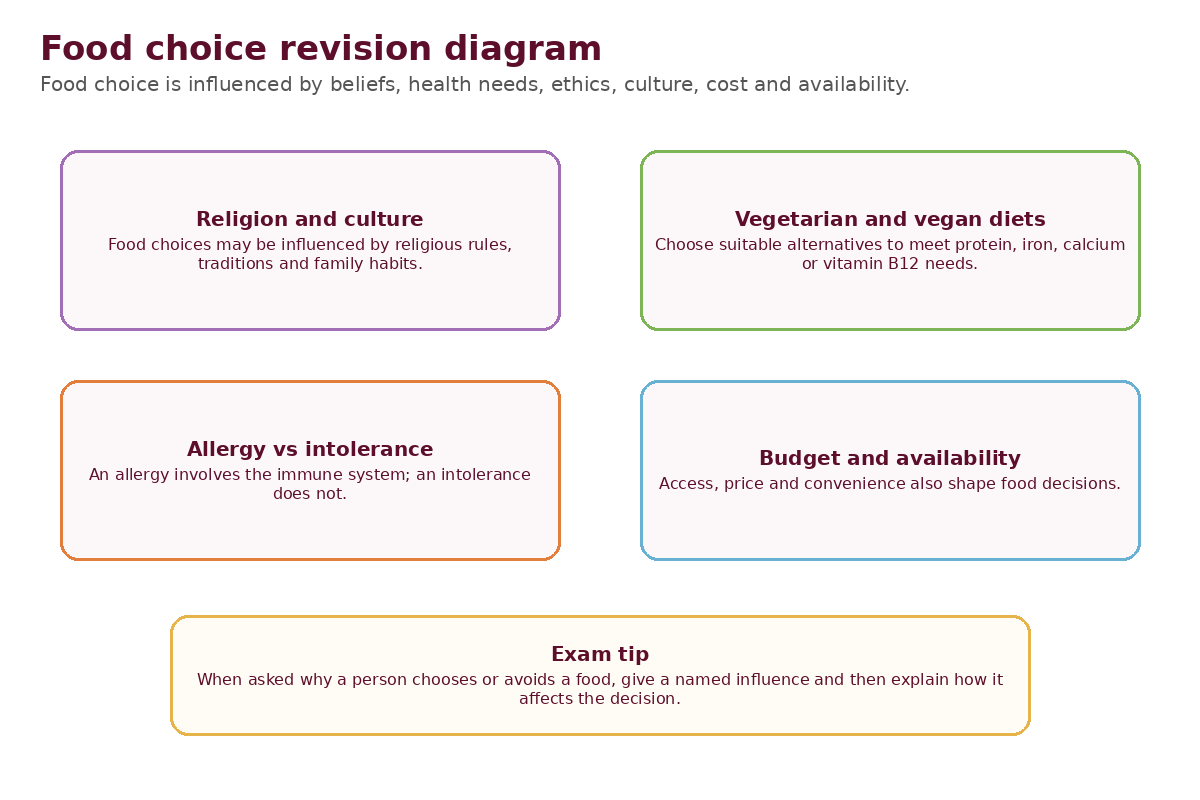
Major influences on food choice, including diet, culture and health needs.
Religion and cultureBeliefs and traditions can shape food choices.
Vegan / vegetarianSuitable alternatives may be needed to maintain nutrient intake.
Allergy vs intoleranceThese are not the same and should be explained accurately.
Practical factorsBudget, availability and convenience influence decisions too.
Sensory preferences
Appearance, aroma, taste and texture strongly influence acceptability. Previous experiences and familiarity also shape preferences; sensory evaluation can help explain consumer responses.
Access and affordability
Household budget, food prices, local shops, transport, time, equipment and cooking knowledge all influence what can realistically be prepared or bought.
Advertising and media
Branding, promotions, packaging, social media and product placement may influence purchasing. Examine nutritional claims critically and compare them with ingredient lists and labels.
Ethical and environmental choices
Animal welfare, fair trade, sustainability, food miles and waste are important to some consumers. Different considerations can pull in different directions.
Quick knowledge checkThink first, then reveal

Give two non-nutritional factors affecting food choice.

Reveal explanation
Examples include budget, cultural traditions, sensory preference, convenience, availability and ethical beliefs.
Practise exam questions →

The Eatwell Guide and balanced choices

The Eatwell Guide illustrates the broad proportions of major food groups for a balanced overall dietary pattern.

Major food groups
The guide shows fruit and vegetables; potatoes, bread, rice, pasta and other starchy carbohydrates; beans, pulses, fish, eggs, meat and other proteins; dairy and alternatives; oils and spreads. High-fat, high-salt or high-sugar foods sit outside the main guide.
Planning a balanced meal
Include varied vegetables or fruit, a starchy food, an appropriate protein source and other foods as needed. Portion needs vary between individuals and over time.
Drinks and hydration
Water and other suitable drinks contribute to hydration. The Eatwell Guide advises drinking regularly through the day and considering the sugar content of some beverages.
Applying rather than copying the diagram
The guide is a representation of the overall diet, not a rule that each plate must match its exact proportions. Meals can differ while the overall pattern remains balanced.
Quick knowledge checkThink first, then reveal

Which Eatwell section contains beans, lentils and tofu?

Reveal explanation
Beans, pulses, fish, eggs, meat and other proteins.
Practise exam questions →

Vegetarian and vegan diets

Distinguish dietary patterns and plan variety and nutrient adequacy appropriately.

Vegetarian dietary patterns
A lacto-ovo vegetarian avoids meat and fish but may eat dairy and eggs. A lacto-vegetarian includes dairy but not eggs; an ovo-vegetarian includes eggs but not dairy.
Vegan diets
A vegan diet excludes foods of animal origin such as meat, fish, eggs, milk and honey. Plant foods, suitable alternatives and fortified products can support a varied diet.
Protein quality and variety
Soya foods, tofu, pulses, nuts, seeds, wholegrains and mycoprotein may feature in meat-free meals. Combining varied sources helps supply essential amino acids; not all plant protein sources are identical.
Nutrients needing attention
When excluding animal foods, plan reliable vitamin B12 sources (typically fortified foods or suitable supplements), plus iron, calcium, iodine and other nutrients as needed. Follow age-appropriate reliable guidance.
Quick knowledge checkThink first, then reveal

Would a cheese omelette be suitable for a vegan?

Reveal explanation
No. It contains eggs and cheese, both of animal origin.
Practise exam questions →

Religious and cultural food requirements

Food choices can reflect religious rules, festivals, family traditions and diverse cultural cuisines.

Halal and haram
In Islam, halal means permitted and haram means prohibited. Pork is prohibited; permitted meat has relevant sourcing and preparation requirements. Ingredients such as gelatine may require checking.
Kosher food
Jewish kosher practices include avoiding pork and shellfish and rules about the sourcing and preparation of meat. Keeping meat and dairy separate is important in traditional kosher practice.
Other religious and individual practices
Some Hindus avoid beef and many choose vegetarian foods; practices vary. Some Buddhists follow vegetarian diets, but this is not universal. Always ask about an individual’s needs rather than making assumptions.
Adapting recipes respectfully
Check ingredients, preparation equipment and contamination risks. Choose suitable substitutes while preserving the dish’s flavour, presentation and nutritional balance.
Quick knowledge checkThink first, then reveal

Why could gelatine be unsuitable for some consumers?

Reveal explanation
It is animal-derived, and its source may conflict with vegan, vegetarian, halal or kosher requirements.
Practise exam questions →

International cuisine and food culture

Culinary practices develop from ingredients, geography, trade, history and social traditions.

Regional ingredients
Examples include rice and soy products in many East and Southeast Asian cuisines; maize and beans in Mexican cooking; olive oil and vegetables in Mediterranean traditions. These are examples, not fixed rules.
Methods and dishes
Different cuisines may use steaming, grilling, roasting, braising or stir-frying. A dish is shaped by local ingredients, equipment and customary flavourings.
Food and identity
Family celebrations, religious events, migration and local food production influence what people cook. Recipes change over time and families may prepare the same dish differently.
Fusion and adaptation
Cooks can combine techniques or ingredients from different cuisines. Explain the choices respectfully and identify modifications accurately rather than claiming a single “authentic” version.
Quick knowledge checkThink first, then reveal

Give one example of how geography influences regional food.

Reveal explanation
Coastal regions may have greater access to fish and seafood, influencing commonly prepared dishes.
Practise exam questions →

Food allergies and food intolerance

Differentiate immune-mediated allergies from other food reactions and plan safe ingredient substitutions.

Food allergy
A food allergy involves an immune response to a particular food protein and can be serious. Symptoms and severity vary, and even small amounts of an allergen may be important.
Food intolerance
An intolerance does not usually involve the same immune mechanism. Lactose intolerance occurs when the body has insufficient lactase to digest milk sugar comfortably.
Common declared allergens
UK regulated allergens include milk, eggs, fish, crustaceans, molluscs, peanuts, tree nuts, soya, wheat/gluten-containing cereals, sesame, celery, mustard, lupin and sulphur dioxide/sulphites above specified levels.
Avoiding cross-contact
Read labels, check sauces and composite ingredients, use suitable utensils and clean workspaces. Replace allergens with appropriate alternatives while maintaining food safety and nutrition.
Quick knowledge checkThink first, then reveal

Why might lactose-free cow’s milk be unsuitable for someone with a milk-protein allergy?

Reveal explanation
Because it still contains milk proteins, even though lactose has been removed or broken down.
Practise exam questions →

Food labels, packaging and marketing

Packaging helps consumers compare products, assess suitability and make informed decisions.

Ingredients and allergens
Ingredients are generally listed in descending order by weight at the time of manufacture. On prepacked food, regulated allergens are emphasised within the ingredients list.
Nutrition declaration
Many packs give energy, fat, saturates, carbohydrate, sugars, protein and salt per 100 g/ml, sometimes with per-portion values. Per-100-g information allows fairer comparison.
Traffic-light labelling
Voluntary front-of-pack traffic lights help compare amounts of fat, saturates, sugars and salt. Colours refer to defined thresholds, not a complete judgement of overall food quality.
Food origin, claims and certifications
Some labels identify provenance, welfare or production standards. Marketing phrases should be considered alongside the ingredients and nutritional information.
Quick knowledge checkThink first, then reveal

Why is comparing foods per 100 g useful?

Reveal explanation
It allows comparison using the same quantity, rather than relying on different portion sizes.
Practise exam questions →

Adapting a dish for a consumer

Good recipe adaptation balances suitability, flavour, safety, nutrition, cost and technical success.

Identify the exact requirement
Establish whether the need is religious, ethical, medical, sensory or practical. A vegan requirement is different from lactose intolerance or a milk allergy.
Choose functional substitutions
Replacing eggs may affect binding and aeration; replacing milk may affect protein, fat and flavour; replacing wheat flour may affect gluten structure. Choose alternatives for both suitability and function.
Review nutrition and sensory qualities
Consider energy, protein, fibre, vitamins, minerals, flavour, colour, texture and appearance of the new dish. A substitute may change several attributes at once.
Use safe preparation
Read packaging carefully and avoid shared utensils where allergen cross-contact is possible. Record changes clearly in the ingredient list and cooking plan.
Quick knowledge checkThink first, then reveal

Why might swapping wheat flour for a gluten-free blend change bread texture?

Reveal explanation
The gluten network no longer forms in the same way, so structure and elasticity may change.
Practise exam questions →