

← Course HubFood Safety Exam Questions →
Windsor Olympus Academy

GCSE Food Preparation & Nutrition

Food Safety · Learn & Revise

YOUR REVISION GUIDE

Learn the knowledge. Apply it to exam questions.

Revise contamination, microorganisms, food spoilage, preservation, manufacturing and consumer safety. Open the explanations, practise a quick knowledge check, then choose Practise exam questions to test your understanding. You can return to these notes whenever you need them.

0 of 8 sections revised

Food safety and the four Cs

Food safety involves preventing harmful contamination and controlling conditions in which microorganisms grow.
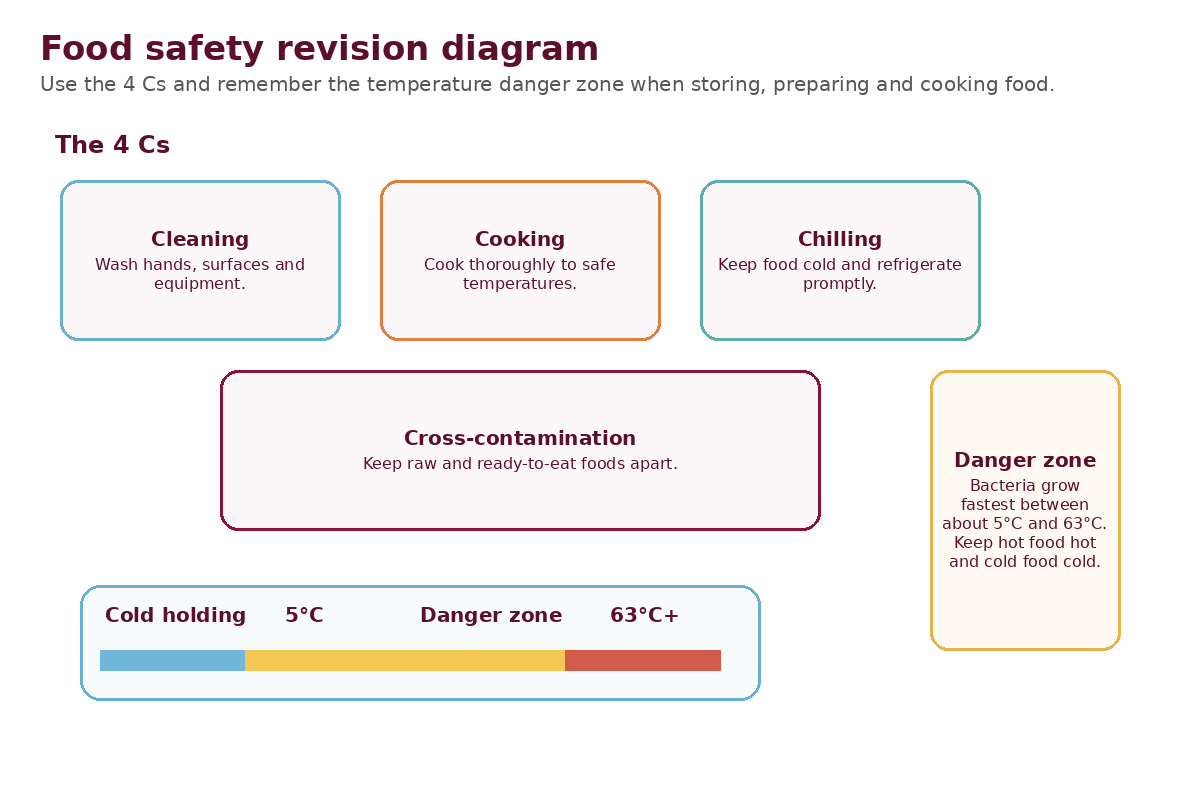
The 4 Cs and the temperature danger zone.
CleaningWash hands, surfaces and equipment thoroughly.
Cross-contaminationKeep raw and ready-to-eat foods apart.
ChillingRefrigerate promptly and keep cold food cold.
CookingCook thoroughly and keep hot food above the danger zone where required.
Cleaning
Clean hands, surfaces, equipment and food-contact utensils appropriately before and during preparation. Cleaning removes dirt; where required, sanitising reduces microorganisms further.
Cooking
Cooking food to an appropriate core temperature helps destroy harmful vegetative bacteria. Thick pieces need sufficient heat throughout; use a clean food probe where required by school procedures.
Chilling
Keep perishable food at safe chilled temperatures and refrigerate promptly. A common UK household recommendation is to set refrigerators to 5°C or below; check equipment and local school policies.
Cross-contamination
Separate raw meat or poultry from ready-to-eat foods. Use appropriate boards and utensils; wash hands after handling raw foods. Bacteria can move through hands, splashes and contaminated surfaces.
Quick knowledge checkThink first, then reveal

Why should raw chicken and prepared salad use separate utensils?

Reveal explanation
To prevent cross-contamination: bacteria on raw chicken could transfer to food that will not be cooked again.
Practise exam questions →

Types of food contamination

Food can be unsafe because of biological, chemical, physical or allergen contamination.

Biological hazards
Biological hazards include harmful bacteria, viruses and parasites. Examples include Salmonella, Campylobacter and norovirus; routes and controls differ.
Chemical hazards
Cleaning fluids, incorrect pesticide residues, unsuitable packaging chemicals and other contaminants can cause harm. Keep chemicals away from food and use them according to instructions.
Physical hazards
Glass, metal fragments, plasters and packaging pieces can contaminate food. Inspect equipment and ingredients; use appropriate protective procedures and reject contaminated products.
Allergen cross-contact
A small amount of an allergenic ingredient can be transferred by shared equipment, utensils or work areas. Accurate ingredient information and preventing cross-contact are essential.
Quick knowledge checkThink first, then reveal

A piece of broken glass falls into a dessert. What type of hazard is this?

Reveal explanation
A physical hazard.
Practise exam questions →

Microorganisms and food poisoning

Recognise that not all microorganisms are harmful, and explain the factors that help pathogens multiply.

Bacteria and conditions for growth
Many bacteria multiply more readily when given suitable food, moisture, time and temperature. Some food-poisoning bacteria grow quickly in the warm temperature range between refrigeration and hot holding.
Foodborne illness examples
Campylobacter is commonly associated with raw poultry; Salmonella may be associated with eggs or poultry; Bacillus cereus can be a risk when cooked rice is mishandled after cooking.
Useful microorganisms
Yeast produces gas during bread fermentation. Lactic acid bacteria help make yoghurt and some cheeses. Controlled fermentation uses selected organisms under suitable conditions.
Spores and toxins
Some bacteria form hardy spores that can survive normal cooking. Other microorganisms can produce toxins. Safe preparation therefore depends on storage and handling as well as cooking.
Quick knowledge checkThink first, then reveal

Why must cooked rice be chilled promptly?

Reveal explanation
Because surviving Bacillus cereus spores can germinate and multiply if rice is kept warm for too long.
Practise exam questions →

Storage, date labels and temperature control

Storage rules differ between raw and cooked foods and between quality and safety labels.

Use-by versus best-before
Use-by is a food safety date: do not eat food after this date, even if it looks or smells fine. Best-before usually refers to quality, and a product may still be acceptable afterwards if safely stored.
Refrigerated storage
Store raw meat sealed and below ready-to-eat foods to avoid drips. Cover food, follow storage instructions and minimise the time perishable food spends at room temperature.
Freezing and defrosting
Freezing slows or stops microbial growth but does not necessarily kill every microorganism. Defrost in a safe way, such as in the refrigerator, and follow product directions before cooking.
Stock rotation
Use first in, first out (FIFO) where appropriate. Label and date prepared foods, check use-by dates and discard food that has been mishandled or is unsafe.
Quick knowledge checkThink first, then reveal

What is the safety difference between a use-by and a best-before date?

Reveal explanation
A use-by date relates to safety; best-before generally relates to product quality.
Practise exam questions →

Food spoilage and indicators

Spoilage involves deterioration in food quality; some but not all spoilage is caused by microorganisms.

Microbial spoilage
Bacteria, moulds and yeasts can cause odours, slime, visible growth and gas production in food. Spoiled food should not be tasted to check whether it is safe.
Enzymic spoilage
Natural enzymes continue to work after harvesting, causing colour, flavour or texture changes. Cut apples may brown enzymically after exposure to oxygen.
Chemical changes
Oxidation can make fats rancid and change colour or flavour. Exposure to light, oxygen and warmth can accelerate some deterioration reactions.
Physical changes
Staling, moisture loss, wilting, bruising and freezer burn affect quality. These may not involve harmful microorganisms but still reduce acceptability.
Quick knowledge checkThink first, then reveal

Why might a packet of crisps develop an unpleasant stale taste?

Reveal explanation
Exposure to oxygen can lead to fat oxidation and rancidity, reducing flavour quality.
Practise exam questions →

Preservation and shelf life

Food preservation works by reducing microbial growth or slowing chemical and enzymic changes.

Chilling, freezing and drying
Chilling slows growth; freezing stops most growth while food remains frozen; drying lowers available water needed for microbial activity. Rehydrated dried foods still need safe handling.
Heat processing
Pasteurisation uses controlled heat to reduce pathogens and spoilage organisms, with refrigeration sometimes still needed. UHT processing uses very high temperatures for a short time with aseptic packaging, giving long unopened shelf life.
Salting, sugaring and pickling
Salt and high sugar concentrations reduce available water in some foods. Pickling creates acidic conditions that inhibit many microorganisms. Correct recipes, concentrations and handling are essential.
Modified atmosphere and vacuum packs
Packaging may change or reduce oxygen exposure and slow quality loss. It does not remove the need for temperature controls: some pathogens can grow in low-oxygen conditions.
Quick knowledge checkThink first, then reveal

How does drying help preserve food?

Reveal explanation
It reduces available water, limiting the growth of many spoilage microorganisms.
Practise exam questions →

Manufacturing, processing and additives

Understand how industrial production transforms food and maintains consistency and safety.

Primary and secondary processing
Primary processing changes raw commodities into usable basic ingredients, such as milling wheat into flour. Secondary processing turns ingredients into food products, such as baking bread.
Food additives
Additives are used for specific functions: preservatives help protect against spoilage; antioxidants reduce oxidation; emulsifiers help ingredients stay mixed; stabilisers and thickeners change texture; colours and flavourings affect sensory qualities.
Fortification and enrichment
Fortification adds nutrients to increase their content. Enrichment can restore nutrients lost during processing. Not all processed products are fortified: always check ingredients and nutrition labels.
Quality assurance and traceability
Manufacturers use checks for safe ingredients, cleaning, heat processes, packaging seals, allergens, batch codes and product recalls. Traceability helps identify affected batches if a problem occurs.
Quick knowledge checkThink first, then reveal

Why might antioxidants be added to foods containing oils?

Reveal explanation
To slow oxidation and help delay rancidity or other quality changes.
Practise exam questions →

HACCP, labelling and practical application

Safe food systems identify hazards and put controls in place before problems occur.

HACCP principles
Hazard Analysis and Critical Control Points identifies likely hazards, stages where control is essential, monitoring procedures and what to do if something goes wrong.
Cooking and chilling controls
Examples of controls include checking a suitable core temperature, promptly refrigerating high-risk food and monitoring refrigerator temperatures. Recording checks supports consistency.
Allergen declarations
UK food businesses must provide accurate information on specified allergens. Prepacked products emphasise regulated allergens in the ingredients list; packaging rules vary by type of sale.
Practical risk assessment
Identify the specific food and activity, judge how harm could happen, use proportionate control measures and report equipment faults or unexpected problems to the teacher.
Quick knowledge checkThink first, then reveal

What does HACCP stand for?

Reveal explanation
Hazard Analysis and Critical Control Points.
Practise exam questions →