

← Course HubFood Science and Cooking Exam Questions →
Windsor Olympus Academy

GCSE Food Preparation & Nutrition

Food Science and Cooking · Learn & Revise

YOUR REVISION GUIDE

Learn the knowledge. Apply it to exam questions.

Connect what happens to ingredients during preparation and heating with reliable cooking methods and practical skills. Open the explanations, practise a quick knowledge check, then choose Practise exam questions to test your understanding. You can return to these notes whenever you need them.

0 of 8 sections revised

How heat travels

Conduction, convection and radiation transfer energy in different ways during cooking.
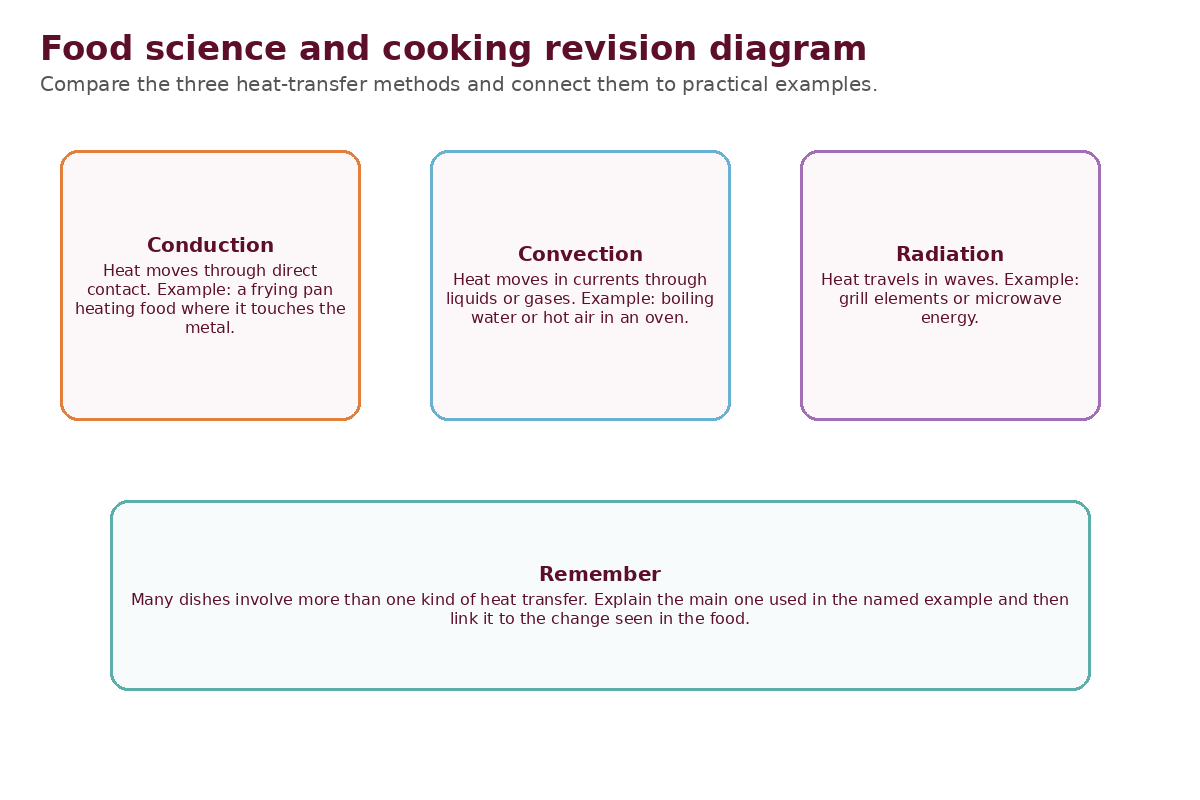
The three main heat-transfer methods used in cooking.
ConductionHeat travels through direct contact.
ConvectionHeat moves in currents through liquids and gases.
RadiationHeat travels in waves, as with grills or microwaves.
Exam focusLink the heat-transfer method to a named cooking example.
Conduction
Conduction transfers thermal energy through direct contact, such as a pan heating food where it touches the surface. Metals generally conduct heat well.
Convection
Convection moves heat through circulating liquids and gases, such as boiling water or hot air in an oven. Movement can make heating more even.
Radiation
Radiation transfers energy by electromagnetic waves; grilling and infrared radiant heat brown and heat food surfaces. Microwaves also transfer electromagnetic energy, interacting mainly with polar molecules in food.
Comparing heat-transfer methods
Most cooking methods use more than one form of heat transfer. For example, an oven circulates hot air, radiates heat from surfaces and transfers heat through the baking tray.
Quick knowledge checkThink first, then reveal

What is the main heat-transfer process when a metal pan touches a piece of food?

Reveal explanation
Conduction through direct contact.
Practise exam questions →

Why and how we cook food

Cooking can improve safety, flavour, texture, digestibility and appearance.

Reasons for cooking
Appropriate cooking may destroy harmful microorganisms, soften certain foods, develop flavours and colours, improve digestibility and make food more appealing.
Moist-heat methods
Boiling, simmering, steaming and poaching commonly use water or steam to transfer heat. They differ in temperature, agitation and suitability for delicate foods.
Dry-heat methods
Baking, grilling and roasting rely heavily on hot air, radiant heat and hot surfaces; these may create browned or crisp outer surfaces.
Frying methods
Stir-frying and shallow-frying generally use relatively small quantities of oil compared with deep-frying. Control temperature, timing and safe handling.
Quick knowledge checkThink first, then reveal

Why is steaming often used for vegetables?

Reveal explanation
Steam transfers heat without immersing vegetables in large volumes of water, which can help limit nutrient leaching.
Practise exam questions →

Food science: protein denaturation and coagulation

Proteins change structure when heated or subjected to other conditions.

Denaturation
Denaturation describes proteins unfolding or changing shape because of heat, acid or agitation. The primary amino acid sequence usually stays intact during ordinary culinary denaturation.
Coagulation
Coagulation is the setting or thickening of protein as denatured molecules interact. Examples include egg white firming during cooking and quiche filling setting.
Eggs and foams
Whisking egg whites unfolds proteins and traps air bubbles. Heat can set the foam; added sugar can help stabilise a meringue during preparation.
Meat and fish
Heating muscle proteins changes structure and moisture retention. Excess cooking can toughen some meats or dry fish; correct timing helps quality and safety.
Quick knowledge checkThink first, then reveal

Why does liquid egg white become firm and opaque when cooked?

Reveal explanation
Heat causes proteins to denature and coagulate, setting the egg white.
Practise exam questions →

Food science: gluten, starch and fermentation

The behaviour of flour, starch and yeast explains common baking results.

Gluten formation
Wheat proteins glutenin and gliadin form gluten when water is added and the dough is worked. Gluten gives a dough elasticity and helps it trap gas.
Starch gelatinisation
Starch granules absorb water and swell when heated in sufficient liquid, thickening sauces and contributing to the setting of baked goods.
Yeast fermentation
Yeast converts available sugars into carbon dioxide and ethanol. Carbon dioxide is retained by dough, helping it rise during proving.
Dextrinisation and browning
Dry heating of starch can create dextrins; Maillard reactions involve reducing sugars and amino groups; caramelisation involves heating sugars. Multiple changes can occur in the same food.
Quick knowledge checkThink first, then reveal

Which food-science process thickens a cornflour sauce?

Reveal explanation
Starch gelatinisation.
Practise exam questions →

Raising agents and aeration

Air, steam and gases from chemical or biological agents can make mixtures rise.

Mechanical aeration
Whisking, beating, creaming and sieving can introduce air into a mixture. In cakes, trapped air expands as the batter heats.
Chemical raising agents
Baking powder releases carbon dioxide when activated by moisture and heat. Bicarbonate of soda can react with acidic ingredients to produce carbon dioxide.
Biological raising agent
Yeast is a living organism; during fermentation, it produces carbon dioxide in suitable doughs. Time and temperature influence its activity.
Steam as a raising agent
Water changes to steam when heated and expands, helping lift choux or puff pastry. Steam must be retained long enough for the surrounding structure to set.
Quick knowledge checkThink first, then reveal

What gas is usually responsible for dough rising during yeast fermentation?

Reveal explanation
Carbon dioxide.
Practise exam questions →

Fats, sugar and emulsions in food

Functional properties explain pastry texture, cake aeration and stable sauces.

Shortening
Fat coats flour and limits gluten formation, making pastry short and crumbly. Using suitable fat temperature and light handling supports the intended texture.
Creaming fat and sugar
Sugar crystals cut tiny air pockets into softened fat during creaming. This can help a cake rise when the trapped air expands in baking.
Emulsification
Oil and water normally separate. Emulsifiers such as egg-yolk lecithin help disperse one phase into another, as in mayonnaise.
Sugar changes
Sugar can sweeten, soften texture, aid preservation and participate in browning. Caramelisation and Maillard reactions are distinct processes.
Quick knowledge checkThink first, then reveal

How does fat help shortcrust pastry become crumbly?

Reveal explanation
It coats flour particles, limiting gluten development.
Practise exam questions →

Preparing, planning and presenting food

Strong practical outcomes depend on preparation, timing, accuracy and hygiene.

Mise en place
Prepare the workspace: wash hands, inspect equipment, measure ingredients, preheat ovens where appropriate and read the method before starting.
Dovetailing a time plan
A dovetailed time plan coordinates stages for more than one dish, using waiting or oven time productively. Sequence high-risk tasks and consider shared equipment.
Accuracy and quality points
Control temperature, cooking duration, ingredient proportions, size and consistency. Specific quality checks include sauce thickness, doneness, flavour balance and presentation.
Safe use of equipment
Select tools for the task, follow teacher instructions and inspect equipment. Knife handling, hot surfaces and electrical equipment require appropriate control measures.
Quick knowledge checkThink first, then reveal

What does dovetailing mean in food preparation?

Reveal explanation
Coordinating stages of different dishes so waiting and preparation time are used efficiently.
Practise exam questions →

Sensory analysis, evaluation and modifications

Use evidence to describe food quality and justify changes.

Sensory characteristics
Evaluate appearance, aroma, taste and texture, using precise words such as golden, citrusy, tender, chewy or crisp where appropriate.
Types of sensory testing
Preference and ranking tests compare liking or order; triangle tests identify differences between samples; star profiles show a product’s intensity ratings across several attributes.
Evaluating against criteria
Compare outcomes to a design specification or intended consumer needs. Distinguish observation (“crumb was dense”) from explanation (“the dough may have been under-proved”).
Justified modifications
Explain how a specific change might improve flavour, colour, texture, nutrient profile, accessibility or suitability. Consider possible trade-offs.
Quick knowledge checkThink first, then reveal

What is a sensory star profile used for?

Reveal explanation
To record and compare intensity scores for sensory attributes such as flavour, aroma and texture.
Practise exam questions →