

← Course HubFruit and Vegetables Exam Questions →
Windsor Olympus Academy

GCSE Food Preparation & Nutrition

Fruit and Vegetables · Learn & Revise

YOUR REVISION GUIDE

Learn the knowledge. Apply it to exam questions.

Review fruit and vegetable commodities, micronutrients, nutrient retention, cooking changes and food provenance. Open the explanations, practise a quick knowledge check, then choose Practise exam questions to test your understanding. You can return to these notes whenever you need them.

0 of 8 sections revised

Classifying fruit and vegetables

Food commodities are grouped by their characteristics and the parts of plants that we eat.
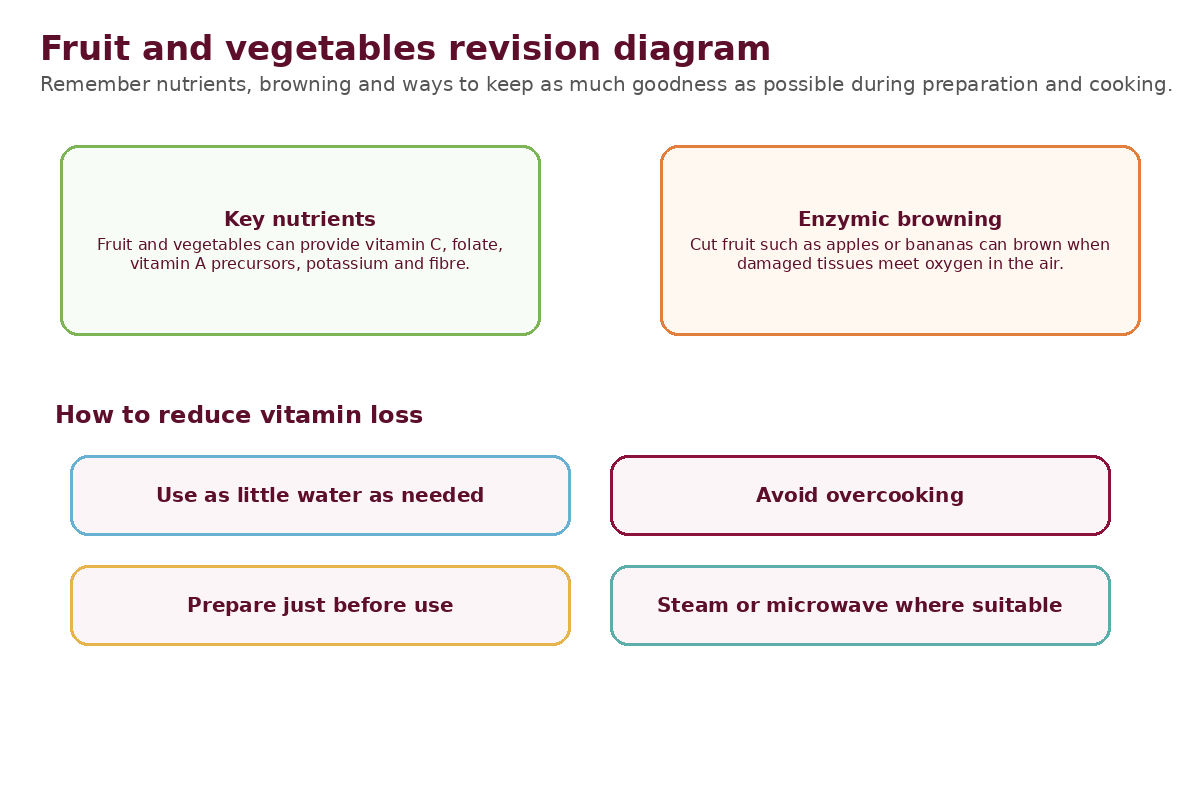
Key nutrients, enzymic browning and ways to reduce nutrient loss.
NutrientsFruit and vegetables often supply vitamins, minerals and fibre.
BrowningEnzymic browning happens when cut surfaces are exposed to oxygen.
RetentionShorter cooking times and less water can help retain nutrients.
ApplicationUse practical examples such as steaming, lemon juice or preparing just before serving.
Fruit classifications
Fruits include citrus (oranges, lemons), berries (strawberries, raspberries), stone fruits (peaches, plums), pome fruits (apples, pears) and tropical fruits (pineapple, mango).
Vegetable classifications
Vegetables can be grouped as roots (carrot, parsnip), tubers (potato), bulbs (onion), leaves (spinach), stems (celery), flowers (broccoli) and seeds/pods (peas).
Botanical and culinary meanings
A tomato is botanically a fruit because it develops from a flower and contains seeds, but is often treated as a vegetable in cooking. A classification question may depend on whether it asks for botanical or culinary use.
Fresh, frozen, canned and dried
Different forms may be convenient and available year-round. Freezing preserves many nutrients; canning involves heat; drying removes moisture. Compare the added sugar or salt and preparation requirements of specific products.
Quick knowledge checkThink first, then reveal

Name one root vegetable and one leafy green vegetable.

Reveal explanation
Carrot is a root vegetable; spinach is a leafy green vegetable.
Practise exam questions →

Vitamins: types, functions and sources

Vitamins are micronutrients, needed in small amounts for normal bodily functions. Know which are fat-soluble and which are water-soluble.

Vitamin A
Vitamin A supports normal vision, immune function and healthy tissues. Beta-carotene in carrots, sweet potatoes and dark green leaves can be converted to vitamin A. Preformed vitamin A also occurs in animal foods.
Vitamin C
Vitamin C supports collagen formation, wound healing and the absorption of non-haem iron. Examples include peppers, citrus fruit, kiwi fruit and broccoli. It is water-soluble and can be lost during preparation and cooking.
B vitamins
B vitamins help support energy metabolism and other functions. Folate (B9) is important for normal cell division and is found in leafy greens and legumes. B12 comes mainly from animal foods or fortified foods, not unfortified vegetables.
Vitamins D, E and K
D helps calcium absorption and bone health; sources include oily fish, eggs and fortified foods, while the skin can make vitamin D in sunlight. E acts as an antioxidant; K contributes to normal blood clotting. Some leafy greens provide vitamin K.
Quick knowledge checkThink first, then reveal

Which vitamin in peppers helps the body absorb non-haem iron?

Reveal explanation
Vitamin C supports the absorption of non-haem iron from plant foods.
Practise exam questions →

Minerals: types, functions and sources

Minerals support structures, fluid balance and essential processes. Sources occur across many food groups.

Iron
Iron is needed to form haemoglobin, which transports oxygen in the blood. Sources include meat, beans, lentils and fortified cereals. Vitamin C eaten with plant sources helps absorption; insufficient iron can contribute to iron-deficiency anaemia.
Calcium
Calcium is important for bones, teeth, muscle contraction and nerve activity. Sources include dairy foods, fortified plant drinks, calcium-set tofu and some leafy vegetables. Vitamin D helps calcium absorption.
Potassium and magnesium
Potassium supports fluid balance and normal muscle and nerve function. Magnesium contributes to energy-releasing processes and muscle function. Fruit, vegetables, pulses, nuts and wholegrains can provide these minerals.
Iodine and zinc
Iodine is required for thyroid hormones; key dietary sources include dairy and fish in many UK diets. Zinc supports normal growth, immune function and wound healing; sources include meat, shellfish, pulses and nuts.
Quick knowledge checkThink first, then reveal

Why is vitamin C useful in a meal containing beans?

Reveal explanation
It helps the body absorb non-haem iron from the beans.
Practise exam questions →

Food preparation skills and knife techniques

Safe, consistent preparation supports quality, appearance and appropriate cooking.

Preparing fruit and vegetables
Wash fruit and vegetables as appropriate, remove inedible parts, prevent cross-contamination and use a stable board. Keep produce that is cut and ready to eat safely stored.
Knife cuts
Julienne means thin matchsticks; dice means cubes; slicing produces thin pieces. Similar sizes promote even cooking and an attractive finish.
Effects of size on cooking
Smaller pieces have a greater surface area relative to their volume. They often cook more quickly but may also expose more nutrients to air or water.
Choosing an appropriate cooking method
Steaming, stir-frying, microwaving and roasting all have different effects on colour, texture, flavour and nutrient retention. Choose based on vegetable type and desired result.
Quick knowledge checkThink first, then reveal

Why should pieces of carrot be cut to a similar size before cooking?

Reveal explanation
Similar-sized pieces cook at a more even rate, improving texture and consistency.
Practise exam questions →

Enzymic browning, oxidation and pigments

Learn the food-science changes that occur when plant tissue is cut or heated.

Enzymic browning
When certain cut fruits such as apples contact oxygen, polyphenol oxidase can trigger browning reactions. Browning may change appearance without necessarily making the fruit unsafe.
Preventing browning
Reduce contact with oxygen, lower the temperature or use an acidic ingredient such as lemon juice. Appropriate blanching can inactivate browning enzymes in some foods.
Pigment changes
Chlorophyll gives green vegetables colour; prolonged heat and acidic conditions can make greens look dull. Anthocyanins in red cabbage and berries can change colour depending on pH.
Oxidation and vitamin loss
Air exposure can promote deterioration in some foods. Vitamin C can be lost through oxidation and into cooking water, especially after cutting, prolonged heating or holding foods warm.
Quick knowledge checkThink first, then reveal

Why can lemon juice slow browning in sliced apples?

Reveal explanation
Its acidity inhibits the browning enzyme; coating also helps reduce the reaction at the surface.
Practise exam questions →

Preserving micronutrients when cooking

Careful preparation and cooking can help retain water-soluble vitamins and other nutrients.

Preparation losses
Peeling thickly removes edible material and some nutrients near the surface; cutting far ahead of use can increase exposure to air. Wash before cutting where practical.
Water-soluble vitamins
Vitamin C and many B vitamins can dissolve into cooking water. Steaming, microwaving or using minimal liquid can reduce leaching compared with long boiling in plenty of water.
Heat and time
Some nutrients are heat-sensitive. Cooking quickly and avoiding prolonged hot holding may help retain vitamins, although cooking also makes some foods more palatable and safe.
Using cooking liquids
Where suitable and safe, using cooking liquid in a sauce or soup can retain some water-soluble nutrients that would otherwise be discarded.
Quick knowledge checkThink first, then reveal

Give one way to reduce vitamin C loss when cooking broccoli.

Reveal explanation
Steam it briefly instead of boiling it for a long time in a large volume of water.
Practise exam questions →

Fruit, vegetables and health

Link nutritional benefits to a variety of foods and dietary recommendations.

The Eatwell Guide
Fruit and vegetables form a major part of the Eatwell Guide. The UK recommendation is to aim for at least five portions of varied fruit and vegetables each day, using suitable fresh, frozen, canned or dried options.
Health benefits
Fruit and vegetables supply fibre, vitamins, minerals and many plant compounds. Variety supports different nutrient needs and overall dietary balance.
Portion considerations
The “five-a-day” recommendation refers to portions, not five individual items. A portion of juice or smoothie has specific limitations and does not replace eating a range of whole fruit and vegetables.
Dietary adaptation
A vegetable-based dish can be adapted for allergies, taste, culture, budget or seasonality by substituting ingredients and adjusting methods without losing sight of balanced nutrition.
Quick knowledge checkThink first, then reveal

Why is variety important when choosing fruit and vegetables?

Reveal explanation
Different foods supply different mixtures of vitamins, minerals, fibre and other compounds, helping meet varied needs.
Practise exam questions →

Seasonality, growing and food miles

Food provenance includes how plant foods are grown, transported, sold and wasted.

Seasonal production
Seasonality describes when a crop is naturally harvested in a region. Seasonal foods can be abundant, but environmental impact depends on growing conditions, storage and transport as well.
Growing methods
Open-field production, greenhouses, hydroponics and organic farming differ in energy, land, water and pest-control requirements. Outcomes depend on the crop and management practices.
Food miles and sustainability
Food miles measure distance travelled, not total environmental impact. Refrigeration, air freight, heating greenhouses, fertiliser and waste may also matter.
Reducing food waste
Plan portions, store foods correctly, use leftovers safely and understand the difference between best-before dates (quality) and use-by dates (safety). Composting unavoidable scraps can divert waste.
Quick knowledge checkThink first, then reveal

Why might imported outdoor-grown tomatoes have a lower footprint than local greenhouse tomatoes in winter?

Reveal explanation
The greenhouse may require substantial heating energy; distance alone does not determine total emissions.
Practise exam questions →