

← Course HubFood Provenance and Sustainability Exam Questions →
Windsor Olympus Academy

GCSE Food Preparation & Nutrition

Food Provenance and Sustainability · Learn & Revise

YOUR REVISION GUIDE

Learn the knowledge. Apply it to exam questions.

Understand where food comes from and evaluate production systems, environmental impact, food security and waste. Open the explanations, practise a quick knowledge check, then choose Practise exam questions to test your understanding. You can return to these notes whenever you need them.

0 of 8 sections revised

Food provenance and food systems

Provenance is the origin and journey of food from production to consumption.
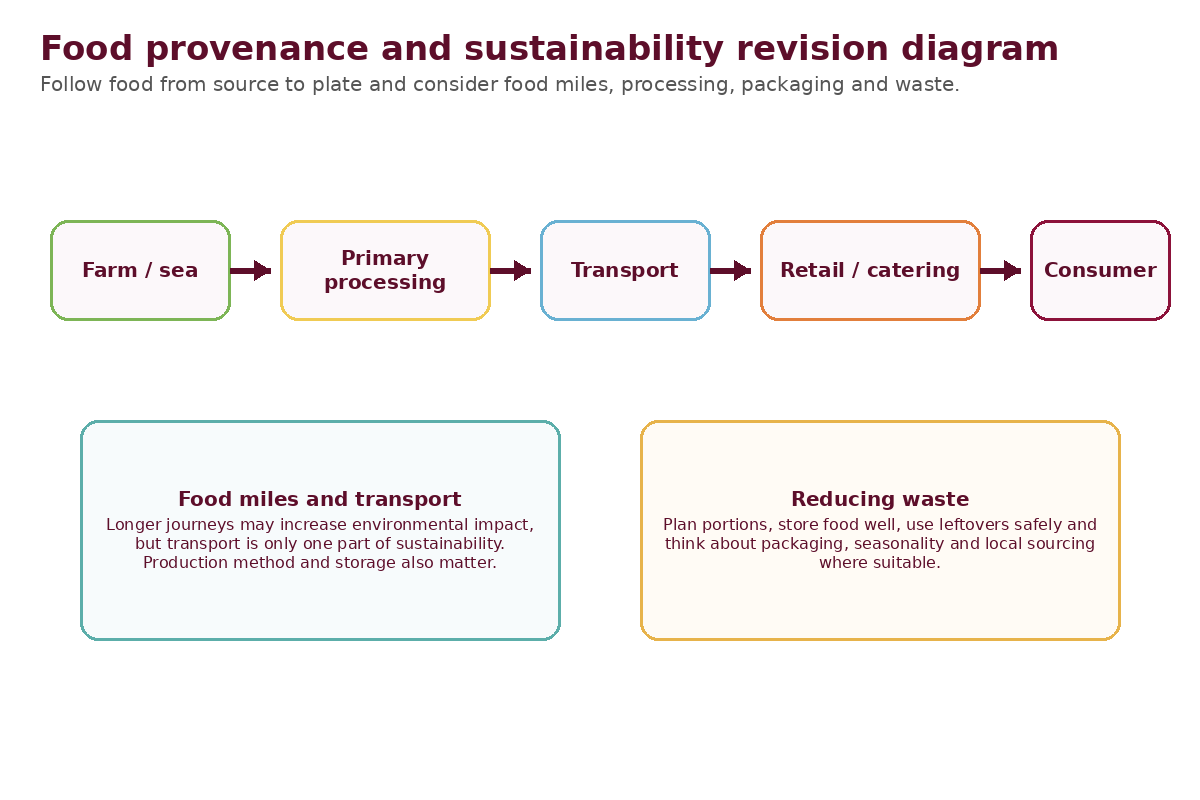
Farm-to-fork journey, food miles and reducing waste.
ProvenanceThis means where food comes from and how it is produced.
Supply chainFood moves through stages such as farming, processing and retail.
SustainabilityTransport, packaging, storage and production methods all matter.
Waste reductionGood planning and storage can reduce avoidable food waste.
What food provenance means
Food provenance includes where food was grown, reared or caught, how it was produced, processed, transported and sold. Traceability helps identify its origin.
Food supply chain
A chain may include producers, processors, distributors, retailers, caterers and consumers. Storage and transport at each stage can affect safety, availability and environmental impact.
Primary and secondary processing
Primary processing prepares raw commodities, such as milling wheat or pasteurising milk. Secondary processing creates products from ingredients, such as bread or yoghurt.
Labels and traceability
Origin information, batch identifiers and certification schemes can help identify the production route. The meaning and reliability of claims depend on the actual scheme.
Quick knowledge checkThink first, then reveal

What does food provenance describe?

Reveal explanation
The origin and production journey of food, including how and where it is produced.
Practise exam questions →

Farming methods and animal production

Compare agricultural practices using context, evidence and more than one sustainability factor.

Intensive and extensive production
Intensive farming typically uses higher inputs or production density per area or animal, while extensive systems use lower stocking densities or inputs across larger areas. Both have potential benefits and costs.
Organic farming
Organic standards restrict certain synthetic pesticides and fertilisers and set other production rules. Organic is a defined production approach, not a guarantee of zero environmental impact.
Animal welfare
Welfare considers animals’ health, ability to express normal behaviours and appropriate housing and husbandry. Labels and assured schemes may provide specific standards.
Crop production
Fertiliser, irrigation, pest management, soil care and equipment affect yield and environmental impact. Techniques such as crop rotation can contribute to soil management.
Quick knowledge checkThink first, then reveal

Why might crop rotation be used?

Reveal explanation
It can help manage soil fertility and pests, depending on the crops and farming method.
Practise exam questions →

Fishing, aquaculture and seafood

Fish supply chains raise questions about stocks, production methods and aquatic ecosystems.

Wild fishing
Wild capture involves catching fish in their natural environment. Sustainability depends on stock health, fishing rates, habitat impacts and bycatch.
Aquaculture
Aquaculture means farming fish or other aquatic organisms. It can provide a managed supply, though feed, water quality, waste and disease management need attention.
Overfishing and bycatch
Overfishing removes fish faster than stocks can sustainably recover. Bycatch is the unintentional capture of non-target species.
Choosing seafood responsibly
Check credible current sourcing information and certification where applicable. Sustainability can vary significantly by species, fishing area and method.
Quick knowledge checkThink first, then reveal

What does bycatch mean?

Reveal explanation
The unintended capture of species other than the target catch.
Practise exam questions →

Food miles, carbon footprint and transport

Distance matters, but measuring environmental impact needs a wider life-cycle view.

Food miles
Food miles are the distance a food travels through the supply chain. They do not automatically show the emissions from growing, heating, processing and storage.
Carbon footprint
A food’s carbon footprint is an estimate of greenhouse gas emissions associated with its life cycle. Land use, production method, energy sources, refrigeration and transport can all contribute.
Air freight and shipping
Air transport typically creates higher emissions per tonne-kilometre than shipping, but comparisons depend on the quantity, route, product and total supply chain.
Local and seasonal choices
Seasonal outdoor-grown food may avoid energy-intensive growing or long-term storage, but local production can sometimes still use more energy than imports.
Quick knowledge checkThink first, then reveal

Why might food miles be an incomplete measure of sustainability?

Reveal explanation
They measure transport distance, not emissions from farming, heating greenhouses, processing and storage.
Practise exam questions →

Environmental resources: land, water and biodiversity

Food production uses resources and can change ecosystems.

Water use
Irrigation, livestock systems and processing use water. Impact depends on local water scarcity, season and production method, not only the litres used.
Land use and habitat
Converting forests or grassland to agriculture can damage habitats and increase emissions. Responsible management aims to limit unnecessary conversion and soil degradation.
Biodiversity and ecosystems
Pollinators, soil organisms and other wildlife contribute to food systems. Pesticide choices and habitat protection influence biodiversity.
Energy and packaging
Growing, refrigeration, processing and transporting food need energy. Packaging adds resources but can also extend shelf life and reduce waste; decisions need balance.
Quick knowledge checkThink first, then reveal

How can packaging sometimes reduce a food’s environmental impact?

Reveal explanation
It may extend shelf life and prevent food waste, offsetting some of its resource use.
Practise exam questions →

Food waste and resource efficiency

Avoidable food waste wastes the land, water, labour, energy and money used to produce food.

Types of food waste
Waste can occur during farming, processing, retail, catering and in homes. Some waste is edible and avoidable; other waste includes unavoidable inedible parts.
Date marks and storage
Use-by relates to food safety, whereas best-before usually concerns quality. Correct refrigeration, stock rotation and storage help avoid unsafe food and unnecessary disposal.
Planning and portioning
Plan quantities, use suitable portion sizes, adapt recipes to available food, and use leftovers when they have been safely stored and reheated as appropriate.
Waste hierarchy
Preventing waste is usually preferable to dealing with it after it occurs. Redistribution of suitable surplus food, composting and other routes can reduce impacts, but food safety remains essential.
Quick knowledge checkThink first, then reveal

Why can reducing bread waste reduce environmental impact?

Reveal explanation
It avoids wasting the energy, water, land and labour used to grow wheat, mill flour and make bread.
Practise exam questions →

Food security, poverty and access

Access to sufficient, safe and nutritious food depends on social, economic and environmental systems.

Food security
Food security is when people have reliable physical, social and economic access to sufficient safe and nutritious food. It includes availability, access, use and stability.
Food insecurity and poverty
Food insecurity may result from low income, rising prices, conflict, climate events or unreliable supply. Families may face difficult trade-offs between cost, availability and nutritional variety.
Practical responses
Affordable pulses, frozen vegetables, planned meals and appropriate community support can help within particular circumstances, but structural causes such as income and availability also matter.
Global supply issues
Drought, flooding, crop disease, poor infrastructure and disruption to trade can affect yields and prices. Resilience may improve through diversified crops and supply chains.
Quick knowledge checkThink first, then reveal

What is food security?

Reveal explanation
Reliable access to sufficient, safe and nutritious food for an active, healthy life.
Practise exam questions →

Making evidence-based sustainable choices

Sustainable food decisions involve considering nutrition, affordability, welfare and environmental impacts together.

Trade-offs
One product may use less packaging but more refrigeration; another may be locally produced but require heated greenhouses. Compare actual conditions rather than slogans.
Alternative proteins
Beans, lentils, tofu and other foods may offer alternatives to some animal products. Environmental effects vary by production method, processing and diet context.
Responsible consumer choices
Plan meals, reduce waste, use credible origin and sustainability information, choose suitable seasonal foods and avoid purchasing beyond what can be used safely.
Evaluating claims
Ask which environmental measure is reported, what stages were included and whether evidence is current. General claims such as “eco-friendly” need supporting details.
Quick knowledge checkThink first, then reveal

Why might a product with local ingredients still have a high environmental impact?

Reveal explanation
Production may need substantial energy, fertiliser, water or land, even when transport distances are short.
Practise exam questions →